The Universal Commerce Protocol (UCP), announced by Google is designed to enable agentic commerce by providing a common language that allows AI agents to autonomously navigate the entire shopping journey on behalf of a customer.
I thought it would be worth listing the primary use cases for UCP and categorise them by how they will shape agent-led shopping.
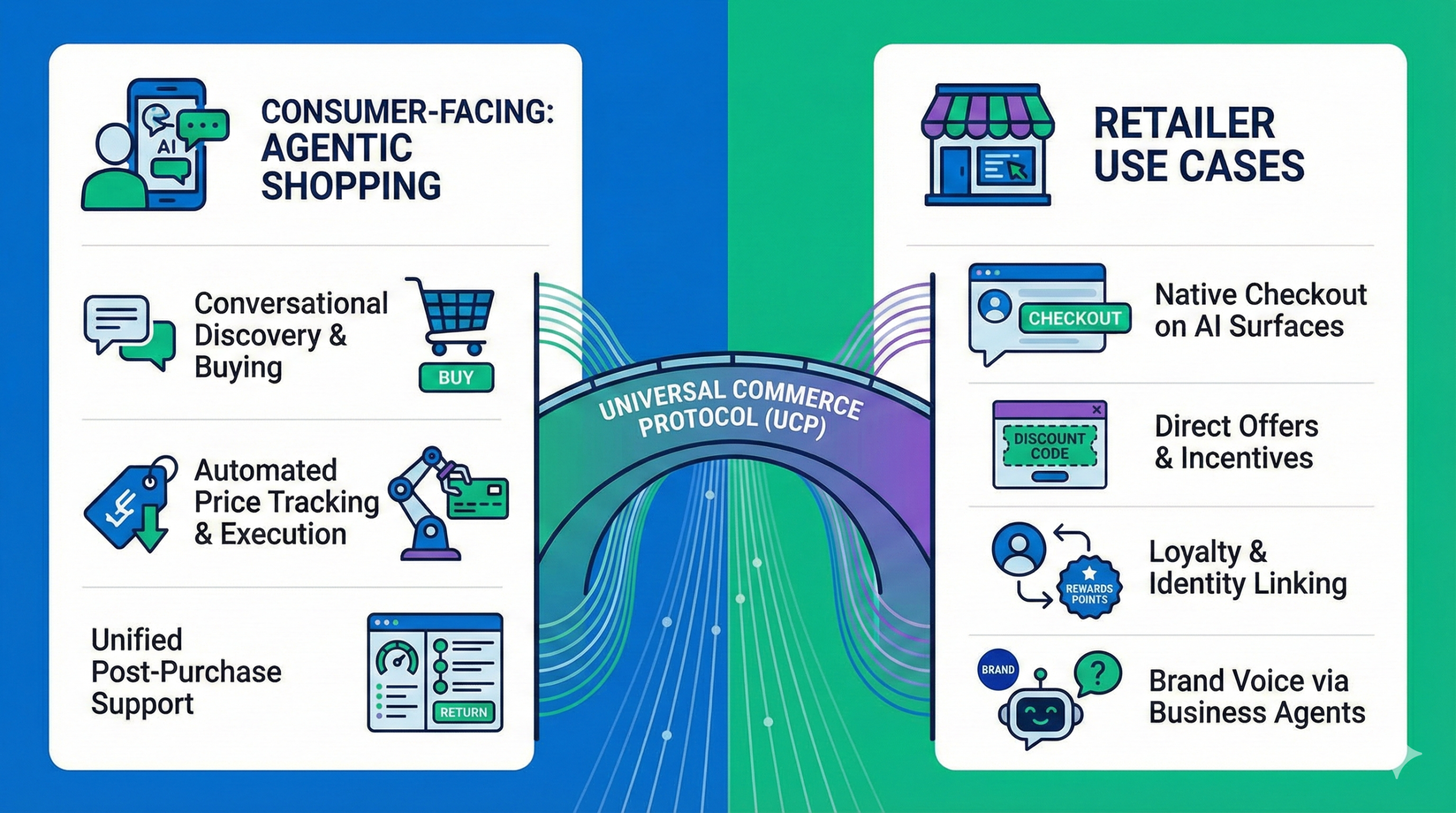
Consumer-Facing Use Cases (Agentic Shopping)
The most visible use case for UCP is turning AI assistants from “search engines” into “buying agents.”
- Conversational Discovery & Buying: A user can say, “Find me a lightweight carry-on suitcase under £200 and buy the best one for me.” The AI uses UCP to check real-time inventory at retailers like John Lewis or Selfridges, compare product specs, apply available discounts, and complete the purchase without the user ever leaving the chat interface.
- Automated Price Tracking & Execution: AI agents can monitor products for price drops or restock alerts. Because UCP standardises the checkout flow, the agent can execute a purchase the moment a specific price target is hit, using pre-saved preferences (size, color, budget).
- Unified Post-Purchase Support: Instead of checking five different retailer apps for shipping updates, UCP allows an AI agent to aggregate tracking info, initiate returns, or ask customer service questions across multiple merchants using a standardised communication layer.
Retailer Use Cases
For retailers, UCP is designed to reduce the “friction” that leads to abandoned carts.
- Native Checkout on AI Surfaces: Retailers can enable “Native Checkout” within an AI app like Gemini. This allows a customer to buy a product the moment they discover it, reducing the drop-off rates associated with redirecting users to a mobile website.
- Direct Offers & Incentives: Through UCP, retailers can feed specific “Direct Offers” into AI conversations. For example, if an AI agent is comparing two pairs of running shoes, a brand can programmatically offer a 15% discount code through UCP to win the sale in real-time.
- Loyalty & Identity Linking: UCP supports account linking. This means a John Lewis or Selfridges customer can link their loyalty account to an AI model like Gemini. The AI agent can then apply member-only pricing, use existing rewards points, and suggest products based on past purchase history.
- Brand Voice via “Business Agents”: Retailers could use UCP to power “Business Agents” customised AI personalities that live within Search to answer highly specific product questions (e.g., “is this case small enough to carry-on and Easyjet flight?”) and close the sale immediately.
Traditional vs. UCP-Powered Commerce
| Feature | Traditional eCommerce | UCP-Powered (Agentic) |
| Discovery | Scrolling through links/ads | Conversational recommendations |
| Checkout | Redirect to website; manual entry | Native, one-tap AI execution |
| Discounts | Manually finding/pasting codes | Automated “Direct Offers” |
| Returns | Logging into individual accounts | Unified AI-managed returns |
| Merchant Role | Seller of Record | Remains Seller of Record (Direct) |